Dr.STONE x Space Travelium TeNQ Unveils ROAD TO THE MOON
Dr.STONE x Space Travelium TeNQ Unveils ROAD TO THE MOON
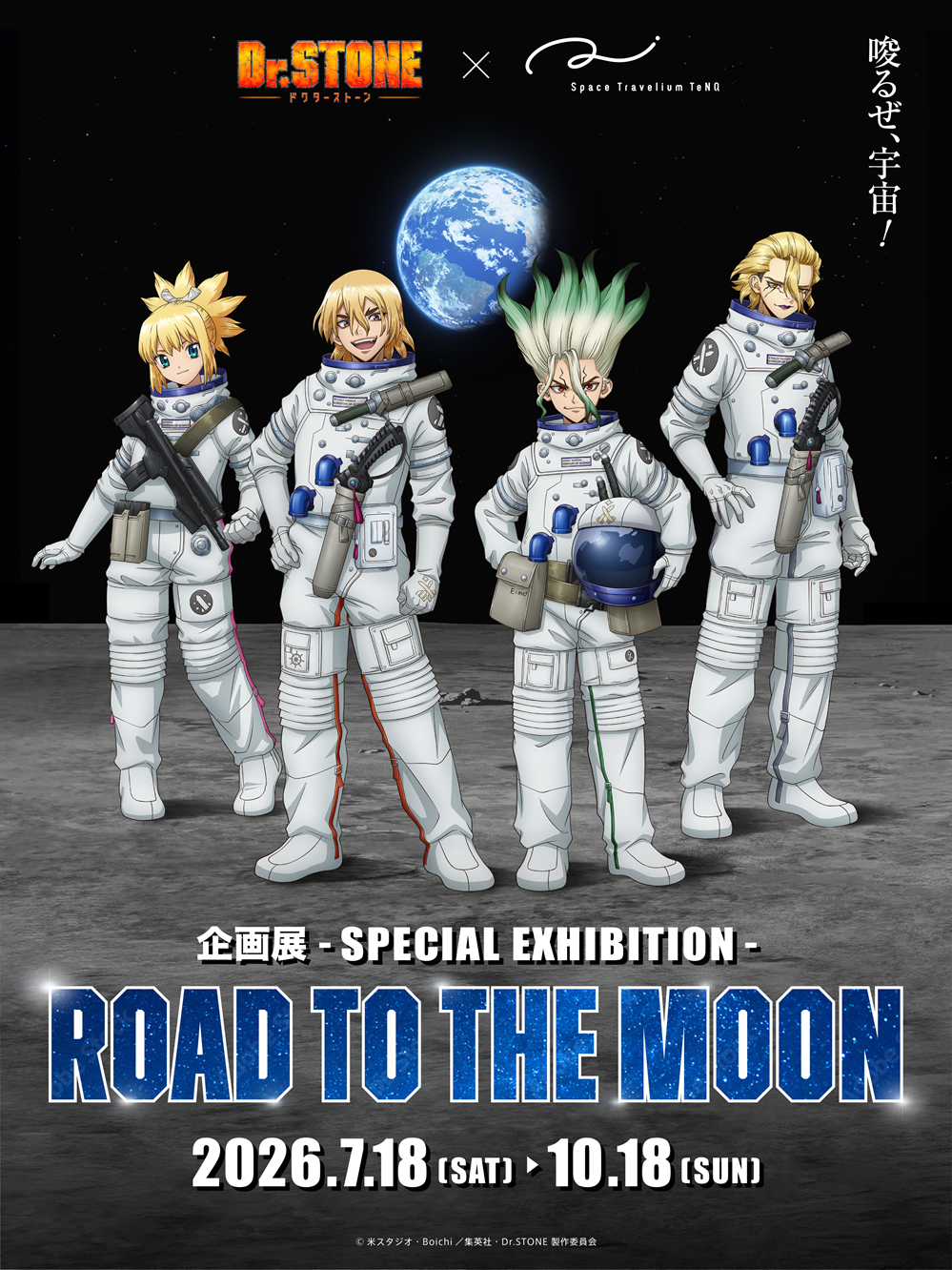
On June 15, 2026, Tokyo Dome's Space Travelium TeNQ announced a new collaboration exhibition with Dr.STONE, and it did so with a newly drawn key visual that immediately makes the premise clear: the series' space-seeking energy is being turned into a real-world museum experience. The exhibition, titled ROAD TO THE MOON, will run in the facility's special exhibition area from July 18 to October 18, 2026.
The official Tokyo Dome page says the visual features four members of the Space Selection team in spacesuits, while the PR Times release expands on the exhibition's scope with a breakdown of the visitor experience. This is not a simple poster wall or a one-room photo corner. The plan is organized into zones that guide visitors from the story's setup, through its science-and-space journey, and all the way to a moon-landing style finale with photo spots and hands-on displays.
The announcement also includes a set of event extras: birthday campaigns for characters with dates during the exhibition period, limited original goods attached to selected tickets, and in-house merchandise tied to the collaboration. In other words, the project is designed to work both as a fan service event and as a museum-style learning space that extends the anime's themes into a physical visit.
What Was Announced
The headline item is the newly drawn key visual, which centers the four astronaut-like characters against a moonlit backdrop. The page makes clear that this visual is not decoration alone; it is the anchor for the exhibition's identity. Space Travelium TeNQ and Dr.STONE are both built around curiosity, problem-solving, and the idea of looking upward, so the collaboration feels unusually aligned rather than random.
The exhibition itself is divided into three major zones. Zone 1 introduces the world of Dr.STONE with story basics, character information, and a timeline. Zone 2 explores the path toward space with memorable scenes, a recreation of the power-generating moment, and an explanation of the starry sky seen by Senku and the others after 3,700 years. Zone 3 brings the visit to its climax with moon-themed photo spots, displays of scientific inventions, participatory elements, and a corner where visitors can photograph stuffed toys against the main visual.
On top of that, the event adds the kind of small, limited-time incentives that Japanese collaboration culture does well: birthday campaigns for the relevant characters, special merchandise, and a ticket option with original goods. Those extras may sound secondary, but they help turn an exhibition from a short stop into a repeatable fan destination.
Why It Matters
There are two reasons this stands out. First, Dr.STONE is a series about science, experimentation, and building toward the impossible through methodical progress. A space-themed exhibition is a natural extension of that narrative logic. It does not just borrow the characters' popularity; it translates the show's worldview into physical space.
Second, the collaboration sits at the intersection of anime fandom and Tokyo tourism. Space Travelium TeNQ is part of Tokyo Dome City, so the project is not only for readers who already know the manga or anime. It is also for visitors who may be looking for an experience that combines a current anime brand with a destination they can actually visit while in Tokyo.
For international fans, that makes the announcement more than a local promotional tie-in. It is a concrete example of how Japanese venues use anime to build immersive experiences that are easy to understand even if you have not followed every episode. The premise is simple, the visual is striking, and the physical exhibition gives the collaboration a stronger memory than a social-media post would.
Context for International Fans
If you follow anime news from outside Japan, this is the kind of announcement that explains why collaboration culture matters. Japanese exhibitions often go beyond a framed poster and a few merchandise shelves. They build zones, narrate a path through the story, and use location-specific design to make the anime feel present in the real world.
Dr.STONE is especially suited to that approach because the series already treats scientific problem-solving as entertainment. The exhibition's astronomy and moon travel framing lets Space Travelium TeNQ connect the fiction to its own mission without stretching the concept. For a visitor, that means the collaboration should feel coherent rather than branded by force.
It is also worth noting that the exhibition is included in facility admission, which lowers the barrier for casual visitors. That matters for overseas readers planning a Tokyo itinerary, because it suggests this is meant to fit into a normal museum visit instead of requiring a separate event ticket in every case.
What Happens Next
The exhibition opens on July 18, 2026 and continues through October 18, 2026. The official event page should be the place to watch for any changes to ticketing, special goods, or campaign details. If the collaboration follows the usual rhythm for these projects, additional promotional materials may appear as the opening date gets closer.
For now, the announcement gives fans a clear hook: if you want to see Dr.STONE's science-forward energy turned into a real venue experience, this is one of the more coherent anime collaborations on the summer calendar.
Sources
Information was checked on 2026-06-24 20:07:46 JST.


Comments
Post a Comment